
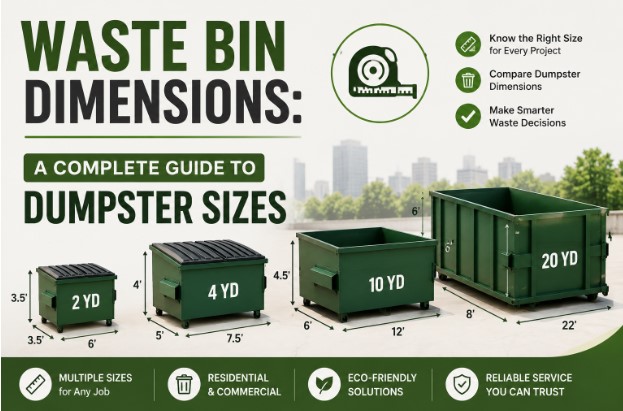
Choosing the right container starts with understanding waste bin dimensions. A dumpster may have enough volume for your project but still be unsuitable if it cannot fit in the available space or handle the weight of your materials.
Dumpster dimensions vary by provider, so published measurements should be treated as approximate. Before booking, confirm the exact dimensions and delivery requirements with the rental company.
Why Waste Bin Dimensions Matter
Understanding the physical size of a dumpster helps you determine whether it will work for your property and project.
The right dimensions can help you:
- Confirm the bin will fit on your property
- Leave enough room for delivery and pickup
- Estimate how much waste it can hold
- Choose an appropriate container for your project
- Avoid unnecessary additional pickups
Remember that capacity and physical dimensions are different. Two dumpsters with similar cubic-yard capacities may have different lengths, widths, and heights.
Common Waste Bin Sizes
4-Yard Waste Bin
A 4-yard bin is a compact option for smaller waste-management requirements.
Typical applications include:
- Small commercial waste
- Office cleanouts
- Minor property maintenance
- Small amounts of household debris
Because of its relatively compact footprint, it can be useful where available space is limited.
10-Yard Dumpster
A 10-yard dumpster is commonly used for smaller renovation and cleanup projects.
It may be suitable for:
- Garage cleanouts
- Bathroom renovations
- Basement cleanups
- Small landscaping projects
- Household junk removal
A typical 10-yard container may measure approximately 12–15 feet long, 7–8 feet wide, and 3–4 feet high, although exact dimensions vary by provider.
20-Yard Dumpster
A 20-yard dumpster provides substantially more capacity and is often suitable for medium-sized projects.
Common uses include:
- Kitchen renovations
- Flooring replacement
- Deck removal
- Larger cleanouts
- Medium construction projects
Typical dimensions may be around 20 feet long, 8 feet wide, and 3–4 feet high, depending on the manufacturer and rental company.
30-Yard Dumpster
A 30-yard container is designed for larger projects generating significant quantities of debris.
It can be appropriate for:
- Major home renovations
- Commercial remodeling
- Construction projects
- Large property cleanouts
- Demolition work
Typical dimensions may be approximately 20 feet long, 8 feet wide, and 5–6 feet high.
40-Yard Dumpster
A 40-yard dumpster is generally among the largest standard roll-off containers available.
It may be used for:
- Large construction projects
- Commercial renovations
- Major demolition
- Large-scale cleanouts
- New construction
A typical 40-yard dumpster may measure around 20–22 feet long, 8 feet wide, and 6–8 feet high, but exact specifications vary.
Waste Bin Dimensions Comparison
|
Bin Size |
Approximate Length |
Approximate Width |
Approximate Height |
Typical Uses |
| 4 yard | Varies | Varies | Varies | Small cleanups |
| 10 yard | 12–15 ft | 7–8 ft | 3–4 ft | Small renovations |
| 20 yard | ~20 ft | ~8 ft | 3–4 ft | Medium projects |
| 30 yard | ~20 ft | ~8 ft | 5–6 ft | Large renovations |
| 40 yard | 20–22 ft | ~8 ft | 6–8 ft | Major construction |
These figures are general industry estimates, not universal specifications.
How Much Space Do You Need?
The dumpster itself isn’t the only consideration. Delivery trucks require additional clearance to safely place and retrieve the container.
Before scheduling delivery, check:
- Driveway or placement-area dimensions
- Overhead clearance
- Gate width
- Nearby trees and structures
- Utility lines
- Vehicle access
- Local parking or placement restrictions
Avoid placing the container where it blocks emergency access or creates an unsafe obstruction.
Choosing Dimensions Based on Your Project
Don’t choose a dumpster based solely on physical size.
Consider both volume and material weight.
For example, heavy materials such as concrete, brick, soil, and asphalt can reach weight limits quickly. Lighter materials such as furniture, cardboard, wood, and household junk generally allow you to make better use of a larger container’s volume.
Tips for Loading a Waste Bin
To use your dumpster efficiently:
- Break down bulky furniture and cardboard.
- Place heavier materials toward the bottom.
- Distribute weight evenly.
- Keep debris below the maximum fill line.
- Don’t allow materials to extend beyond the container.
- Follow the provider’s loading instructions.
Overfilled or improperly loaded bins can create transportation and safety problems.
Frequently Asked Questions
What are the dimensions of a 20-yard dumpster?
A typical 20-yard dumpster may be approximately 20 feet long, 8 feet wide, and 3–4 feet high. Exact measurements vary by provider.
How big is a 10-yard dumpster?
A typical 10-yard dumpster may measure roughly 12–15 feet long, 7–8 feet wide, and 3–4 feet high. Always verify the exact specifications before ordering.
Is a 40-yard dumpster always the best choice for a large project?
Not necessarily. Material weight, available space, and local transportation limits can make a smaller container more appropriate.
Do all dumpsters with the same capacity have identical dimensions?
No. Dumpster dimensions vary by manufacturer and rental provider. Cubic-yard capacity indicates volume, not a standardized physical shape.
Conclusion
Understanding waste bin dimensions makes it easier to select a dumpster that fits both your project and your property. While 10-, 20-, 30-, and 40-yard containers are common options, their exact measurements can vary between providers.
Before renting, consider the amount and type of waste, available placement space, delivery access, and weight restrictions. Confirm the exact container dimensions with your rental company to ensure the bin is suitable for your project.